
Somewhere around the point when your business starts to feel busy, the paperwork begins to pile up. Invoices sit unchecked, and the bank reconciliation you promised yourself last month is still waiting. That is when many owners ask whether to hire someone or pay for outsourced bookkeeping. Both routes can work. The right one depends on your workload, the control you want and what the arrangement really costs.
What’s the Real Difference?
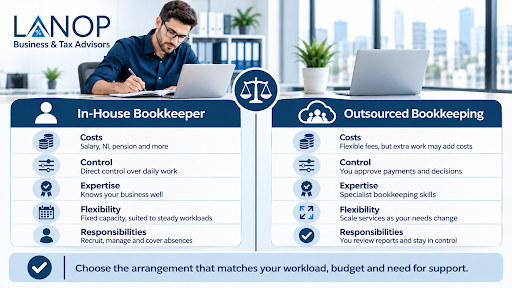
The In house bookkeeper will be an employee on your payroll who knows the business inside out.
The Outsourced bookkeeper will work under an outsourced contract. The bookkeeper will complete a specific set of tasks. They will be either a team player or a contractor with defined roles.
Outsourced bookkeeping does not automatically mean they will provide accountancy services, tax returns, payroll or statutory reporting. Please check the terms of your agreement.
The Case for Hiring In-House
They can quickly answer any questions that your suppliers may have and explain to them why they incurred the cost in March.
Plus there is employer NI, pensions, holiday pay, sick pay, recruitment costs, software and so on.
You also need a manager.
It is often not worth employing a full time bookkeeper for a few hours per week.
The Case for Outsourcing
You can pay for a company to do the work for you. No need to recruit staff, plan holidays or worry about staff being off ill at VAT time.
The positives of using a good company are that they will be able to identify common problems which occur in many businesses, for example regular banking fees or double invoicing. The service can be scaled up or down depending on how much work you have so you’re only paying for what you need.
However there are also some negatives. The response time may be slow, and there may not be clear roles meaning nobody is responsible for any issues until they arise. Some companies will charge a premium fee for out of scope work.
What Does It Really Cost?
Many people think they’ll just have to pay a monthly fee.
Taking an example salary of £30k. Using the 2025/26 rates for Employers we can calculate. 15% on anything above £5k = £3,750 (NI). Minimum contribution of 3% on qualifying earnings (£6,240 to £50,270) = £712.80. This brings your total to £34,462.80 excluding any costs for Software, Hardware, Holiday and Recruitment.
Always check the latest rates on GOV.UK.
Most external costs are charged using a monthly retainer, hourly rate, volume or bespoke cost. The more bank accounts, VAT, Payroll, currencies and reporting you have the higher the price. Always request your fee schedule in writing as often there will be separate charges for set up and catch up.
| Cost area | In-house employee | External provider |
| Salary or service fee | Annual salary | Monthly or hourly fee |
| Employer National Insurance | Applies | Not an employment cost for you |
| Workplace pension | Applies | Not an employment cost for you |
| Holiday and sickness cover | Your responsibility | Provider’s responsibility |
| Extra work | May need more staff time | May attract extra fees |
Compare the same workload on both sides. A cheap quote that leaves out half your tasks is no bargain.
Does Outsourcing Mean Losing Control?
No. Delegate the tedious tasks and stay in control of your finances
You can be the only person that can approve payments, set spending limits and approve major expenses. With your bookkeeping outsourced all transactions will be recorded and reports provided to help you make informed decisions.
Give your bookkeeper a unique login with only the necessary permissions. They shouldn’t be able to approve payments unless you truly need them to. We’ll send you a monthly reconciliation report and have a brief chat.
Is It Safe to Share Financial Records?
Banking data will include personal and business information. Any provider who handles personal data must comply with the UK GDPR. This means having a written data processing agreement.
Ask them if they offer safe file sharing, multi factor authentication, and how quickly they would inform you of a data breach. If they are based outside the UK ask where your data is being processed.
What Happens When Mistakes Happen?
Duplicate payment to supplier. This would be caught within a few weeks by a monthly check but will have gone unnoticed for 3 months. It is easy to reclaim at this stage.
Your contract should identify who will report any mistakes, who will investigate, will you pay for any corrections and how quickly the provider will respond. All corrections should have an audit trail.
So, Hire In-House or Outsource?
It depends how complex the process is, how much time you need to spend and whether you have internal coordination issues.
If you have mid-level transaction volumes, flexible workloads and don’t require daily onsite support, then outsourcing makes sense. However, if you have high daily transaction volumes, regular cash or stock activity and multiple departments requiring instant support, an in-house bookkeeper would make more sense.
Many growing businesses are in the middle. The team will approve payments and look at reports whilst the external bookkeeper will record transactions and perform reconciliations.
Switching Providers Without Losing Records
Ensure all records are in order, reconciliations are current and opening balances are accurate. Ensure you have a clear handover in place, detailing what will be done and by when. Be clear on what the termination clauses in your current contract state. It will likely take a couple of weeks to get everything handed over. Be sure to keep your own copies of everything.
When Should You Bring in Professional Support?
Keep your bookkeeping as a tool to help your business and not take up your evenings. If you are finding reconciliations are constantly getting left behind then you might need some help.
Our professional bookkeeping service can do all of the busy work without you losing control. Find out more here.
Frequently Asked Questions
Is outsourcing bookkeeping cheaper?
It can be. Often once you add in National Insurance, Pension, Recruitment and Holiday provision an employee will cost more.
How much does outsourcing bookkeeping cost in the UK?
This depends on how many transactions you have, how many bank accounts, the amount of VAT and payroll you have. Always ask for a written fee structure.
Can I maintain control of my payments?
Yes. You’ll have control over what gets paid and what decisions are made. Your bookkeeper will record and produce reports.
If we have accounting software such as Xero or QuickBooks do we still need a bookkeeper?
Yes. Although much of the work will be done automatically by the software there is no judgement to see if something is right.
Can we change providers during the year?
Yes. If you plan ahead you can gather your information together, make sure that all reconciliations are up to date and agree on a date to pass things over.
Conclusion
Think about the total costs, how much control and support you will require and how it will affect you with varying volumes.
If you’re unsure, Lanop Business & Tax Advisors can help you work through your workload and costs. The correct outsourcing solution will provide you with the right level of control within your budget.